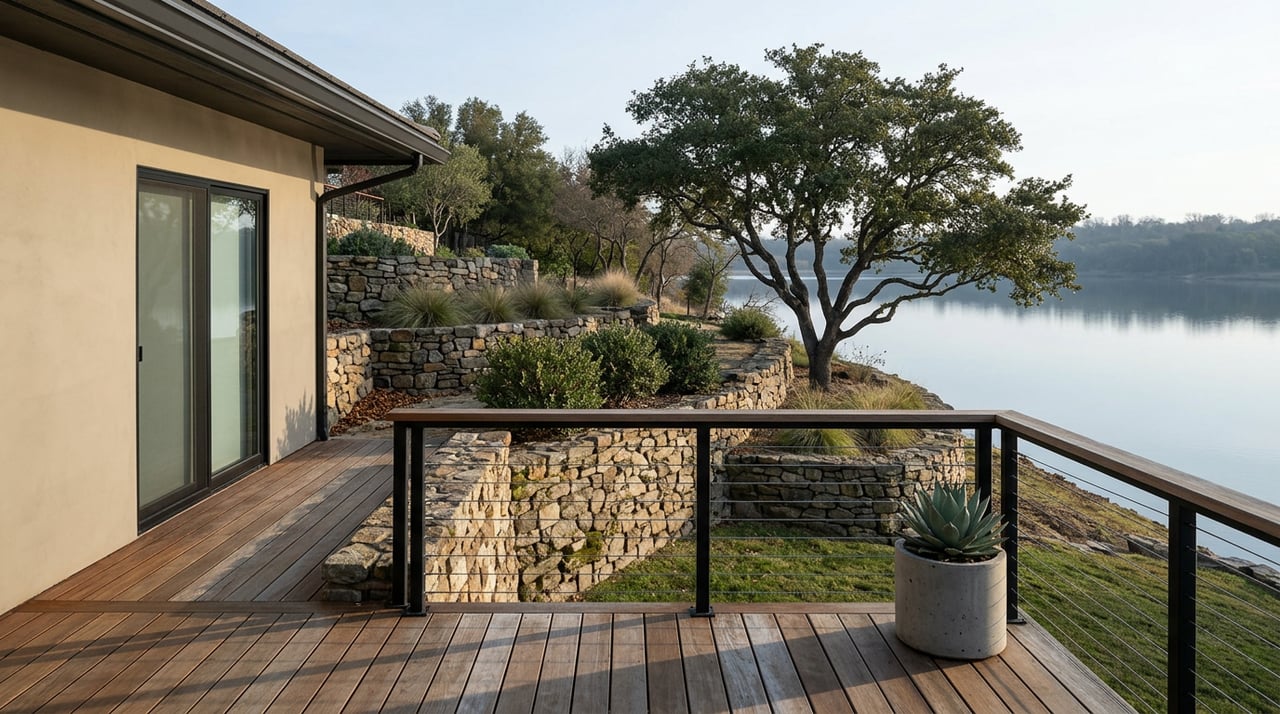
Ask ten people what "lake view" means at Lake Isabella and you'll get ten different waterlines. Tour a listing in June and the water might be lapping at the retaining wall below the deck. Tour the same property in October and that view could be several hundred yards of exposed lakebed. Neither photo is staged. Neither agent is lying. The lake itself is the variable, and understanding why is the difference between buying with clear eyes and buying based on the day you happened to visit.
Lake Isabella isn't a natural lake that happens to have a dam at one end. It's a reservoir, full stop, built in 1953 when the U.S. Army Corps of Engineers dammed the Kern River and put the original town of Kernville underwater in the process, which is why present-day Kernville sits on higher ground than the town that came before it. The Corps still runs the show. Every foot the water rises or falls is a release decision, not weather alone, and the reservoir typically peaks in June and bottoms out in January as the Corps draws it down to make room for the next winter's snowmelt.
The decade when "full" didn't mean full
Here's the part most listing descriptions skip. For more than ten years, Lake Isabella wasn't allowed to fill anywhere close to its stated capacity. Safety concerns with the aging earthen dam led the Corps to cap the reservoir at a "restricted pool," roughly two-thirds of its 568,000 acre-foot design capacity, while engineers worked through a dam safety modification project. That project eventually raised the earthen dam itself by 16 feet and rebuilt the spillway, work that was essentially complete in the early 2020s. If you bought a "lakefront" property during those restricted years, you were buying a view calibrated to a lake that was never going to reach its own high-water mark, by design, not by drought.
That history matters for a 2026 buyer because it means the lake you're looking at today has more physical room to rise than the lake most current owners bought into. A dock built to a decade of restricted-pool expectations may sit differently against a fuller lake than its owner assumed when they installed it.
Where the lake actually sits right now
As of late August 2026, the Corps' own gauge data put Isabella Lake's storage at roughly 335,000 acre-feet, which the reservoir-tracking service Snoflo calculated at 142 percent of the historical average for that date. That sounds like an abundant year, and by the reservoir's own multi-decade record, it is. At the same time, a separate lake-level tracker measured the surface at about 32 percent of full pool capacity and 11 feet below the maximum elevation. Both numbers are accurate. They're just describing two different denominators: one compares today to history, the other compares today to the theoretical maximum the lake was engineered to hold.
| Reference point | What it tells a buyer |
|---|---|
| Historical average for the date | Whether this is a wet year or a dry one relative to the past 40+ years |
| Full pool capacity (568,000 acre-feet) | The physical ceiling the reservoir was built to hold, rarely reached |
| Typical seasonal pattern | Peaks around June, bottoms out around January, every year |
A listing photo taken at peak pool in June and a walkthrough scheduled in November can legitimately show two different shorelines on the same property, and both are honest.
What the low water actually looks like on the ground
The practical texture matters too. When the pool drops, the Borel Canal, a concrete-lined channel that runs beneath the surface on the lake's western end, becomes a real hazard for boaters who don't know it's there. Boat ramps around the lake close or restrict launching on their own schedules tied to water depth, not a single lake-wide announcement, so a dock listed as functional in a spring MLS photo may not be usable by the time escrow closes in the fall. Swimming is capped at 300 feet from shore regardless of water level. None of this is a reason to avoid the area. Stine Cove Recreation Area and the Paradise Cove beach are genuinely well used by the community. It's a reason to verify current conditions rather than assume the marketing photo is the year-round reality.
The number that should catch a buyer's attention
This is where the reservoir mechanics turn into something you can see in the price data. A market report tracking Lake Isabella listings in May 2026 found homes that actually closed selling at a median of $178,500, with a sale-to-list ratio near 99.7 percent, meaning sellers who priced realistically were getting close to their ask. But the same report counted 142 active listings sitting on the market with a median asking price of just $99,997 and an average of 166 days on market, well below what homes were actually closing for.
That's not a market that's cooling. Broader portal data for the three months ending April 2026 showed Lake Isabella home prices up 4.9 percent year over year, with days on market dropping to 54 from 110 the year prior, a meaningfully faster pace than the stale, underpriced inventory would suggest on its own. Put those two data points together and you get a market where realistically priced homes move quickly and sell near asking, while a large pool of listings sits stagnant at prices low enough to suggest sellers are pricing against something other than current demand, whether that's land parcels mixed into the count, deferred maintenance, or a lingering assumption that the lake behind the property isn't worth as much as it currently is.
A short framework before you write an offer
If you're comparing a Lake Isabella property to other Kern County options, a few questions do more work than a median price ever will:
- What elevation does this property's dock or view actually depend on, and where does that sit relative to the Corps' current pool level?
- Has the seller owned through both restricted-pool years and the post-modification period, and does their asking price reflect the newer, less-restricted lake?
- Is the property in Wofford Heights on the north shore, South Lake, or Mountain Mesa to the south? Each sits at a different relationship to the water and to Kernville upstream, and shoreline behavior isn't identical across them.
- Does the listing's photography match the season you're touring in, or was it shot near June's seasonal high?
None of this makes Lake Isabella a bad place to buy. It makes it a place where the water itself is a variable you can actually check, not a fixed amenity you take on faith.
A few common questions
Does the lake ever look like the postcard photos? Yes, typically around its June peak, when seasonal snowmelt and Corps releases bring it closest to full pool. The gap between that peak and the rest of the year is exactly what a buyer should factor into any "lake view" premium.
How can I check the current water level before making an offer? The Corps of Engineers publishes live storage and elevation data for Isabella Dam, and it's worth checking before you assume a listing's water access matches what you're seeing in photos.
Is a low asking price in this area automatically a good deal? Not necessarily. The gap between median asking and median sold prices in 2026 suggests a chunk of low-priced inventory isn't moving, which is a signal to look closer at why a specific property is priced where it is rather than assuming it's simply undervalued.
If you're weighing a Lake Isabella property against other Kern County communities, or you just want a second set of eyes on what a specific listing's water access really means month to month, Phyllis Lopez has spent decades working Kern County's neighborhoods, lake included. Let's Connect and talk through what you're actually buying before you make an offer.


