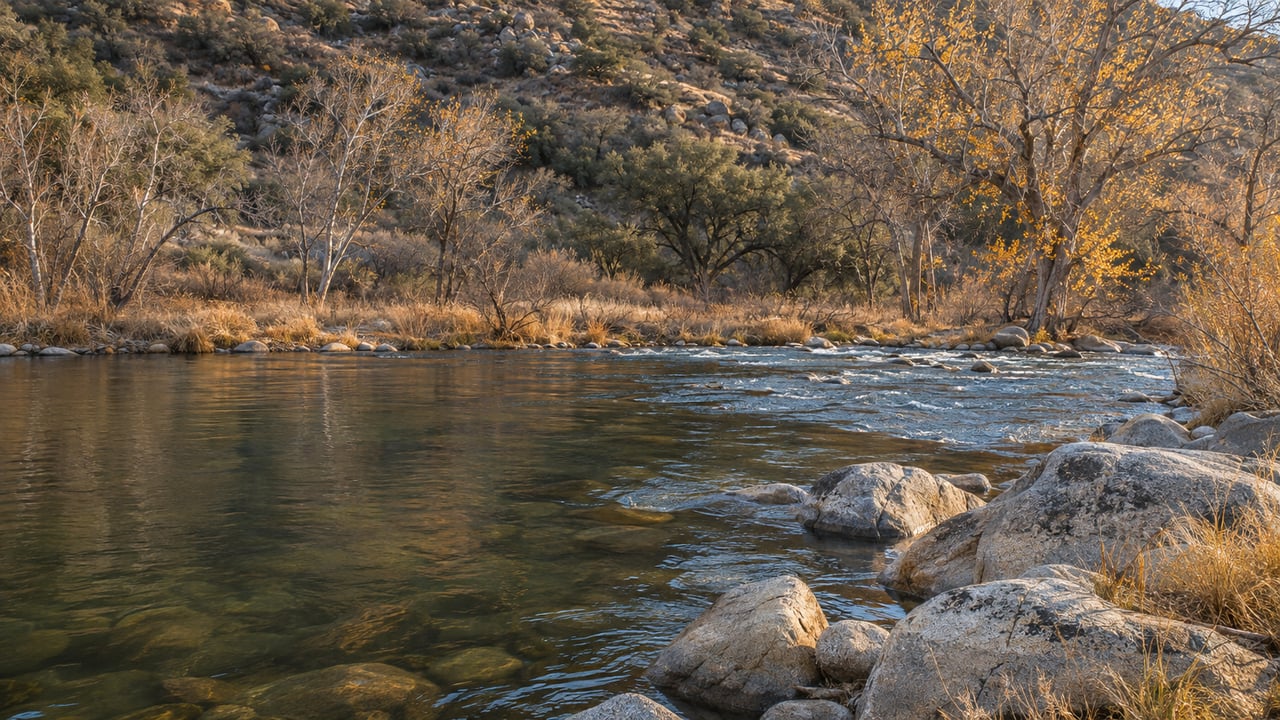
On August 3, the Kern River channel at Yokuts Park was dry except for one small pool. For four months before that, water had run through town in the City of Bakersfield's 2026 River Run. Then the City's water ran out, and the channel went back to the cracked riverbed most longtime residents know. SJV Water photographed it that week.
What fills the channel through Bakersfield comes down to who owns the water and what the law says about leaving some of it in the channel. The California Supreme Court heard that question on October 7. Under the court's own timeline, a written decision is expected around early January.
Where the water went after July 31
The City explained the end of the River Run in a July 22 announcement. From April on, it had used its Kern River supply above what it needed for drinking water and its contract and environmental obligations, and it used that surplus to keep water moving through the channel. By July 31 the surplus was gone. The City's statement says no other supplies were available to keep the River Run going.
Water staff turned the flows down gradually instead of shutting them off all at once. The City said that phased approach helps the river "gently transition from wet to dry conditions." The plan also kept a shorter stretch wet for a while longer. The City's own water, plus exchanges with neighboring agencies, would keep flows running through and past Chester Avenue to the Calloway Pool, just east of Golden State Highway, through September.
That September plan sets the outer limit of this year's river through town. Any flowing water in the channel since then has come from some other arrangement. The same statement lists the places the City recharges surface water when it has water to spare: The Park at River Walk, Truxtun Lakes, and the river channel itself.
Why a big year upstream doesn't keep the river wet in town
One sentence in the City's July statement explains most of the dry riverbed. The City "is limited in its Kern River water supplies and does not have rights to use or direct other water districts' Kern River supplies."
Bakersfield operates the diversion weirs in the riverbed, but the water belongs to many rights holders, including several agricultural districts. In SJV Water's coverage, the river is dry for several miles through Bakersfield in most years. Judge Gregory Pulskamp's 2023 order explains why. Since the mid-20th century, canal enlargements and concrete linings have diverted most of the river's water between the First Point of measurement and the Calloway Weir for agricultural use, which leaves the riverbed below Calloway Weir completely dry for most of the year.
This fall's weather news is a good example. On September 21, Governor Gavin Newsom declared a state of emergency to prepare for the heavy storms El Niño may bring this winter. At a Kern water district meeting in October, a board member asked whether the declaration would change how the river is run. Kern River Watermaster Art Chianello said it would not, and that there were no evacuation plans at the time, SJV Water reported. A wetter winter can mean more water in the system. It doesn't change who controls it.
Whether the law can require some of that water to stay in the channel is the question now before the state Supreme Court.
How a wet year became a lawsuit
The case is Bring Back the Kern v. City of Bakersfield. Bring Back the Kern and Water Audit California sued the City in 2022. They argued that a river left dry through town most years violates the Public Trust Doctrine, which holds that the state owns all water and that it must be put to its highest beneficial use, including public access and the environment.
Then came 2023. As SJV Water put it, an epic water year filled the mostly dry riverbed through town and brought fish with it. The plaintiffs asked for a preliminary injunction, and Kern County Superior Court Judge Gregory Pulskamp granted it. His order relied on California Fish and Game Code Section 5937, which requires dam owners to let enough water run downstream to keep fish in good condition.
The steps since then, with dates:
- November 9, 2023. The formal injunction was filed. A November 14 order put it into effect with a 40% flow formula, based on an agreement between the City and the plaintiffs that the water districts did not join.
- April 2, 2025. The Fifth District Court of Appeal reversed both orders. It held that courts must assess whether a water use is constitutionally reasonable and sent the case back for further proceedings.
- July 2025. The California Supreme Court agreed to hear the plaintiffs' appeal.
- January 2026. In the trial court, Judge Pulskamp dismissed a separate fish-passage claim under Section 5901. The Public Trust and Section 5937 claims stayed in the case, Maven's Notebook reported, republishing SJV Water.
- October 7, 2026. The justices heard oral argument.
According to SJV Water, the last time the Supreme Court ruled on a Kern River case was 140 years ago, and that 1886 decision set the basis for California's water rights system.
The question the justices are weighing
The City and the agricultural districts argue that Judge Pulskamp should first have figured out how much water fish need, then weighed that need against other uses under Article X, Section 2 of the California Constitution, which requires every water use to be reasonable. The plaintiffs argue that Section 5937 was written to carry out that constitutional rule, so water for fish is automatically a reasonable use. The Attorney General's office filed briefs supporting Judge Pulskamp's reading, and SJV Water reported that the outcome could affect river conservation cases across California.
Chief Justice Patricia Guerrero raised that tension minutes into the argument, SJV Water reported:
"But the statute doesn't say anything about what happens when there are multiple competing uses, each of which is reasonable. What happens in that scenario?"
The justices also asked who carries the burden of proof on reasonableness. Attorney Colin Pearce, arguing for the City, said the plaintiffs needed to show why water should be taken from other uses and how much they needed. When Associate Justice Leondra Kruger pointed out that courts usually decide the disputes parties bring to them, Pearce answered, "Water is different."
People in Bakersfield followed the argument together. Bring Back the Kern hosted a watch party at Dagny's Coffee Co. According to 23ABC, Gary Bray, president of the Kern River Fly Fishing Club, was there and said, "There's gotta be a way to allow for water for drinking and for communities and for agricultural. We need both, right?" The City told 23ABC it does not comment on active litigation.
The dates ahead
The Supreme Court's own booklet says the court files its written opinion within 90 days after a case is submitted, which normally happens at oral argument. Counting 90 days from October 7 lands on January 5, 2027. The Chief Justice can vacate a submission by order, which would move that date.
That ruling will settle the legal standard but not the whole lawsuit. In August, the underlying trial was moved back to October 4, 2027 so the Supreme Court appeal could go first.
| Date | What's scheduled | Source |
|---|---|---|
| Around Jan. 5, 2027 | 90-day mark for a Supreme Court opinion, counted from the Oct. 7 argument | Supreme Court booklet |
| Late spring 2027 | Target for the last railroad bridge on the Friant-Kern Canal trail | 23ABC |
| Oct. 4, 2027 | Trial in Bring Back the Kern v. City of Bakersfield | SJV Water |
Whatever the court decides, the City's River Run will keep depending on its own variable supply each year. The ruling will decide how a court weighs water for fish against everyone else's claims when the plaintiffs ask for flows.
A new way to reach the river path from the northwest
The Kern River Parkway trail runs alongside the channel whether the river is wet or dry, and northwest Bakersfield is about to get a much easier way onto it. 23ABC reported on October 23 that a six-mile trail along the Friant-Kern Canal is about 95% complete. When it's finished, it will connect northwest Bakersfield to the parkway path, which runs from Lake Ming to Lake Buena Vista.
Councilmember Bob Smith described the problem the trail solves: "Ward 4 and the Northwest was always the most difficult to access the Kern River Parkway. Because you've just got the high-speed arterials of Callaway and Coffee to get to it."
The section from Coffee Road and Rosedale Highway north to 7th Standard Road is done, and cyclists are already riding it, including Kevin Talley, owner of Grizzly Cycles in northeast Bakersfield. The gap is a railroad crossing between Rosedale and Brimhall at Truxtun. Smith said the railroad has given final approval and the last bridge piece has been ordered, with the bridge hoped to be in place by late spring 2027. The City plans an official grand opening once the full six miles are finished.
If the bridge arrives on schedule, the trail link will open a few months after the court's expected ruling. And whatever the justices decide, the River Run that put water under the Chester Avenue bridge from April through July came from the City's own surplus, set aside one year at a time.
Questions about the river and the trails along it come up often in conversations about life in Bakersfield, especially from people who remember the channel full in 2023. If you'd like to talk through how parks, trails, and the parkway fit into the part of town you call home, Phyllis Lopez is glad to help. Let's Connect.