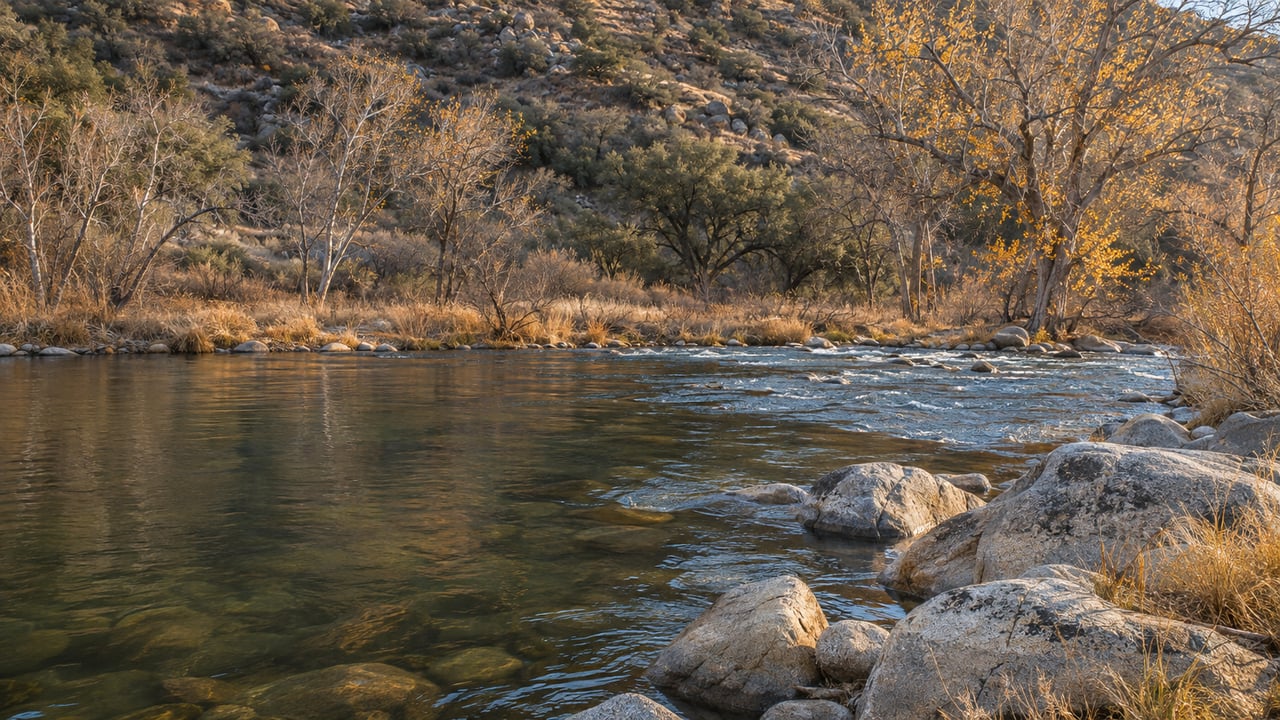
The Kern River Hatchery is at 14415 Sierra Way, about a mile north of downtown Kernville. It has picnic grounds, restrooms and a Fishing and Natural History Museum. The California Department of Fish and Wildlife lists it as "temporarily closed for repairs," and its posted hours are crossed out.
Its raceways have been empty since 2020. Every rainbow trout planted in the Upper Kern since then has been trucked in from the San Joaquin Hatchery north of Fresno. That long haul explains why plants have been thinner and less predictable than they were ten years ago. It also explains why fall 2026 has been unusually quiet on the river.
Riverside Park has been quiet since late September
The Kern River Fly Fishers posted a fishing report on October 27. It said staffing problems at the San Joaquin Hatchery had stopped stocking on the Upper Kern since the week of September 27. The club also noted that high fuel prices and the lack of plants had cut the number of anglers on the river. According to the same report, the Lower Kings River gets priority because it is much closer to that hatchery.
The club's numbers from that day show what's left in the water. Most trout were 8 to 10 inches. Planted holdovers over 11 inches accounted for about one in ten grabs. Flows were about 80 cubic feet per second below Fairview Dam and about 220 above it. The report expected Sections 4 and 5 might get their first plant in a month that week, and it said no CDFW plants had gone into local lakes.
Records drawn from CDFW data show the same gap. The last recorded plant on Kern River Sections 4 and 5 was the week of September 27, 2026. The last recorded plant in Lake Isabella was the week of April 26, 2026. CDFW's provisional 2026 plan still calls for catchable rainbow trout in Lake Isabella in November and December and in Sections 4 and 5 all year. CDFW says plainly that these are plans and not guarantees.
How the drive from Fresno sets the planting schedule
The closure turned a short local run into a round trip of more than 400 miles. In late 2024, CDFW Central Region Manager Julie Vance wrote to the Kern River Fly Fishers about it, and the club published her email. From the 2020 closure to that point, CDFW had planted 208,079 pounds of trout in the Kernville area, roughly 413,445 fish, all from the San Joaquin Hatchery and in just under 300 trips. Before the closure, San Joaquin staff came to Kernville about 14 times a year. Afterward it was six or more times a month. She called that pace "unsustainable" for the hatchery's operations, staff and budget. She also wrote that CDFW "used to do twice as much planting in the area with a functioning Kern hatchery."
The club's own history covers a longer stretch. In a July 2025 report it said the Kern River Hatchery planted more than 145,000 pounds of fertile rainbows in 2005. The same region now gets less than 40,000 pounds of sterile rainbows a year from the San Joaquin Hatchery. SJV Water reported that in its last years before 2020, the Kernville facility worked mostly as a planting base and stocked an average of 80,000 pounds a year.
The trucking also changes where the fish end up. A truck that has to get back up the valley the same day can't spread its load over twenty miles of river the way a crew based a mile from the river could. That's why plants have tended to cluster near Kernville, and why a single short-staffed month at a hatchery near Fresno shows up as an empty bank at Riverside Park.
What reopening the Kernville hatchery would take
The hatchery gets its water through a siphon of about a mile that carries Kern River water from Southern California Edison's Kern River No. 3 powerhouse, known locally as KR3. That siphon has been out of service since 2020. In a November 2025 report, SJV Water said CDFW was spending about $7 million to rebuild it and expected the work to finish in 2027. In September 2025, the Kern Valley Sun ran the headline "Historic Kern River hatchery set to reopen in 2027 after $7 million investment." CDFW's February 2025 alternatives report projected that full water-supply operations would begin in 2028.
The longer-term plan for the site is bigger than restoring the old planting base. CDFW has called a broodstock program for the native Kern River rainbow trout, now a species of concern, a priority for the Kernville facility. An engineering report by McMillen, commissioned by CDFW and completed in February 2025, found that river water alone is too warm for year-round trout rearing. Running a breeding program would mean groundwater wells, chillers and recirculation equipment at a cost of about $27 million. Adding solar to meet the state's net-zero energy goal would cost another $14 million. That full build-out would produce about 200 pounds of Kern River rainbow trout.
Restoring the hatchery as a planting base would cost less, though CDFW had no estimate for that version. The same report said a planting base fed by the river could run only from November through June, because summer water would be too hot for the fish. Even in the best case, then, a reopened Kernville hatchery would be a cool-season operation, and winter is the season when it would matter most.
The license for the hatchery's water source expires November 30
The hatchery's siphon starts at KR3, and Edison's federal license for KR3 expires on November 30, 2026. Edison applied to the Federal Energy Regulatory Commission for a new license on November 22, 2024. The Kern Valley Sun reported on October 29 that federal review was still underway as the expiration date approached.
The project diverts water at Fairview Dam, about 18 miles north of Kernville, and sends it through a flowline of roughly 13 miles to the KR3 powerhouse. That leaves about 15 river miles below the dam with less water. Edison's proposal would move the higher minimum flows below Fairview from July and August to May and June. It would also add low-flow sediment flushing at the dam and a spring recreational boating flow. SJV Water reported that Edison's flow proposal would set aside 40 to 45 cubic feet per second for the hatchery, an amount CDFW has called adequate.
Two local groups, Kern River Boaters and the Kern River Fly Fishers Council, have asked for more. Their May 2026 technical memorandum asks for minimum flows of 195 to 335 cfs below Fairview Dam. The groups describe Edison's proposal as a 40 to 130 cfs schedule. On the state side, the State Water Resources Control Board has published a notice of informal consultation on the relicensing, dated November 4. It accepts written input until 5 p.m. on Friday, November 20, 2026.
The relicensing story connects to the court case over Kern River water through Bakersfield, which is also before the courts this season.
Fishing the valley until the trucks return
CDFW's live fish planting schedule is the quickest way to see whether a truck has reached Kern County in a given week. Hatchery staff update it directly, and it shows the current week, one week ahead and six months of history. If December plants on the lake follow CDFW's provisional calendar, the schedule will show them before Riverside Park does.
Lake Isabella has been a warm-water fishery this fall. The fly club's October report said bass and bluegill were still being caught before the lake cooled. The reservoir was at 24.4 percent of capacity on November 12, 2026, so the shoreline sits well below where a lake view photo from a full year would show it. The same report expected a wet winter, based on NOAA's outlook. It advised checking flows before any trip, because even a 25 percent rise can cloud the water.
For anglers willing to drive, the San Joaquin Hatchery's own priorities point to the Lower Kings below Pine Flat Dam. Its annual brood stock planting was expected within weeks of the October 27 report, and fly club members have fished it from December through March for the past decade.
Closer to home, the Kern River Valley Chamber lists Sierra Gateway Market in Kernville, Mt. Mesa Shell and Crossroads Shell as places to buy a fishing license, and some of them carry bait and tackle. Kern River Fly Shop sells flies, rods and other gear and books half-day, full-day and multiple-day trips with local guides. In spring, the Chamber's Isabella Lake Fishing Derby, held March 28 to 30 this year, has brought planted trout back to the lake.
How the river and the lake are doing is part of what makes a place in this valley feel like home. If you're weighing a move to the Kern River Valley, or wondering what a place near the water is worth today, Phyllis Lopez is glad to talk it through with you. You can also start with our Lake Isabella neighborhood page. Let's Connect.